

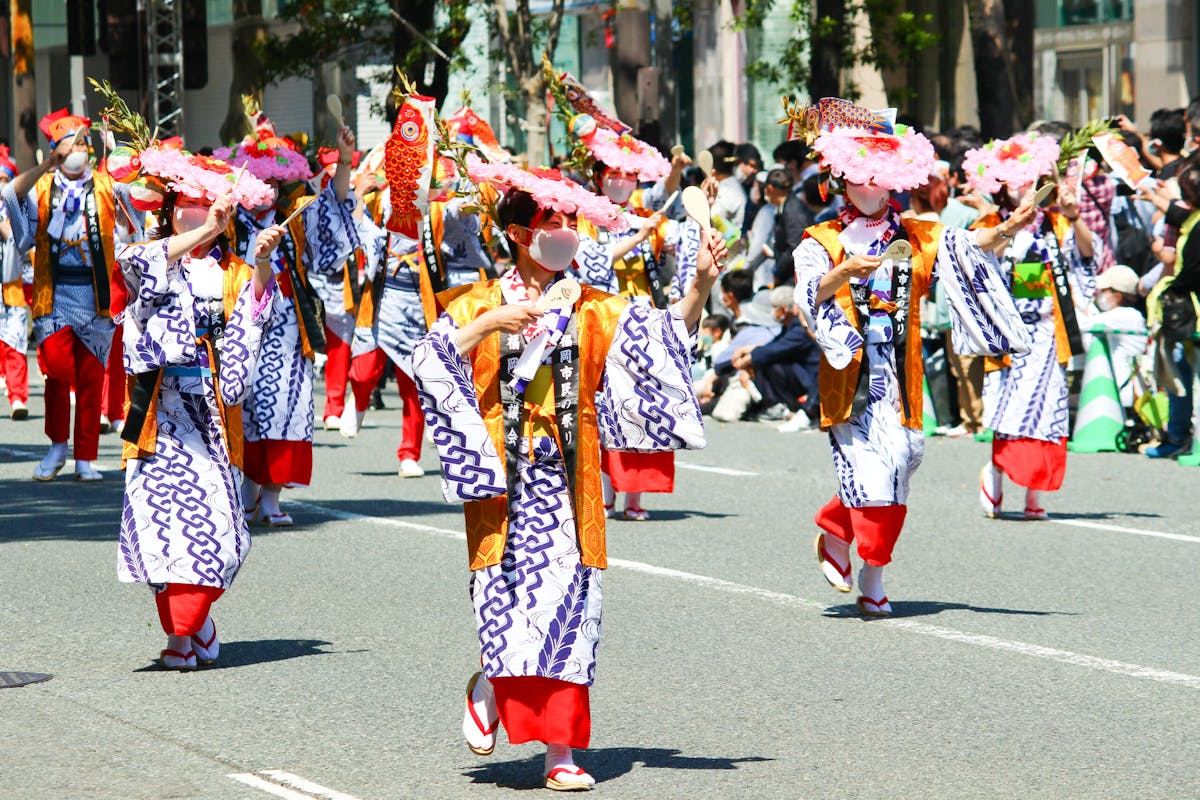
Every year on 3 and 4 May, Fukuoka City hosts one of Japan’s largest festivals – Hakata Dontaku. The festival can trace its origins back over 800 years and has been held nearly continuously since. In recent years, over 2 million people come to Fukuoka just to watch the parade, which features over 35,000 dancers, singers, musicians and other performers.

History
Modern Dontaku dates back to Japan’s Muromachi Period (1336-1573 CE) and was originally celebrated across the country as “Matsubayashi” (松囃子). In fact, records show that the festival started in Kyoto and quickly spread in popularity. At this time, dancers and entertainers would visit the feudal lord to give thanks for everything they did for the people. During this festival, which was originally during the new year, the three gods of fortune and young children were the focus to bring luck for the coming year.

During the Edo period, the celebration shifted from entertainers and performers to Samurai parades that would go to Fukuoka Castle, which was the seat of the Kuroda clan and the Fukuoka Domain, to pay respects. Residents of (now) Fukuoka/Hakata would join the processions away from the castle, performing, visiting shrines and praying for the new year.

Matsubayashi has been held nearly continuously since its inception. It has only had two breaks: 1872 – 1879 (due to financial concerns as the festival did not contribute to the country’s modernisation efforts) and 1941 – 1946 (World War 2).
When it was brought back in 1879, it adopted the name “Hakata Dontaku”. The word “Dontaku” comes from the Dutch word “Zondag”, which means “Sunday” but was also synonymous for “holiday”.
With the adoption of the modern constitution in 1949, Dontaku was standardised to always be on 3 and 4 May, which is at or near the start of Golden Week in Japan.
Hakata Dontaku today
Today, Dontaku is known as a “people’s celebration” (市民祭り, shimin matsuri) and has been celebrated for over 50 years. While it is officially held on 3 and 4 May, there is also an afternoon of events on 2 May that acts as an opening ceremony (although each day also has its own version of opening ceremonies for that day’s events).
While known as “Hakata Dontaku”, it takes place all across the city. Officially, there are over 30 places where events happen. One of the major ones is 市役所前 (“in front of the city office” plaza), where performances from local and national groups happen, including concerts of famous musicians and bands. Another location is in the plaza in front of Hakata Station, where street performances and mini parades happen the morning on both days.
Other major venues include Hakata Port, Sumiyoshi-dori, Gion, Kushida Shrine, West Japan Bank stage (near Hakata Station), and Momochihama. All stages host events all both days, some focusing on the morning and some running all day from approximately 10 a.m. to 6 p.m.
In addition to all of the stage events, the main event of Dontaku remains the parades, which runs approximately 1.5 km / 0.9 miles long along Meiji-dori, turning left at Fukuoka Acros and ending at the city office. One of the largest parades in Japan, it routinely features over 30,000 participants and over 2 million come to Fukuoka to watch it. Many more millions watch it on TV or online, of which there are several livestreams to choose from. These parades happen on both days and feature local dance and performance groups, citizen groups, schools, music associations, companies, and governmental organisations.
How to join
As Dontaku happens all across the city, there are no special conditions for watching. However, participation is strictly regulated due to the size, so you must be part of a group that has registered in advance. Anyone not part of a registered group cannot participate.
Each year, the main parades follow the route in the map below:

The full event map can be seen below:
https://www.google.com/maps/d/embed?mid=1y-9yP_0OV-MfuAkgK50CfnT5XlM6qHw&ehbc=2E312F
If you can not or do not want to join in person, you can also watch online or on your television. If you are in Japan, RKB often broadcasts the parade, with local TV channels in Fukuoka also broadcasting parts of it (especially the parade).
If you are outside of Japan, YouTube lives are your best bet. If you search for “Dontaku” or “どんたく” along with the current year, several will appear. I have linked some that were also broadcasting the festivities in 2025 (the most recent time I watched this festival).
Japan Explorers:

Mainichi newspaper/毎日新聞:


Thanks for reading! Want to do some more exploring? Have a look at the travel map:
If you see this after your page is loaded completely, leafletJS files are missing.
Interested in seeing our social media? Follow us on Instagram for travel photos and Youtube for travel videos!
2 responses to “Hakata Dontaku: One of Japan’s Largest Festivals”
Looks like a really fun time! You going to most of the events?
…Sum1 u no
Yes! I watched the parades (the one from the live streams at the bottom of the post) and went to some of the stages to see performances. I also went to the pre-festival show on Friday from 16:30 to 20:30.